400 years ago, the plant diversity was probably much higher than today. With the land untouched, the forest would have been allowed to grow undisturbed, leading to many of the trees to be older and bigger than their current state today. There also may have been more wildlife around, seeing as our predictions on wildlife found many species that would have been happy in a habitat like NBSP if there were less people around.
Present...
The rest of this blog is about the present state of Site 6, so we're using this space to share our favorite things about the site!
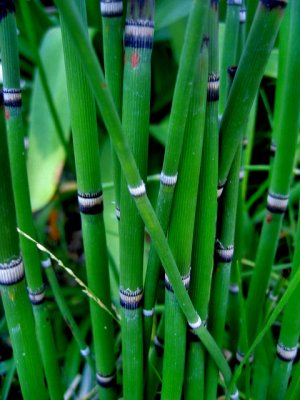
This is Rochelle and my favorite aspect of Site 6 is the cute weird plants shown in the picture to the left. These weird, alien looking plants, also called horsetails, are found on the Eastern side of the site, mostly on the hill. I really liked how out-of-place they looked, as well as the fact that they came apart in segments.
(picture found at the Illinois Wildflowers Info website)
My favorite part of Site 6 is the stream. It is pretty small, but clearly has a huge impact on the surrounding landscape.
-Faren
100 years from now...
As of today, the flat part of Site 6 has very few grown trees, but many saplings and seedlings. In 100 years, these will be much older and larger trees, but the flats on the whole will remain relatively tree-less due in part to the stream's flooding. As the stream continues to get larger and flood, during the spring and heavy rains, in 100 years the stream bank will be larger and shallower after continuous years of the streams wearing it down. The rest of Site 6 will remain largely the same in 100 years, just with more old trees and a more dense forest, as the current and future forest should have the same high levels of biodiversity.
